
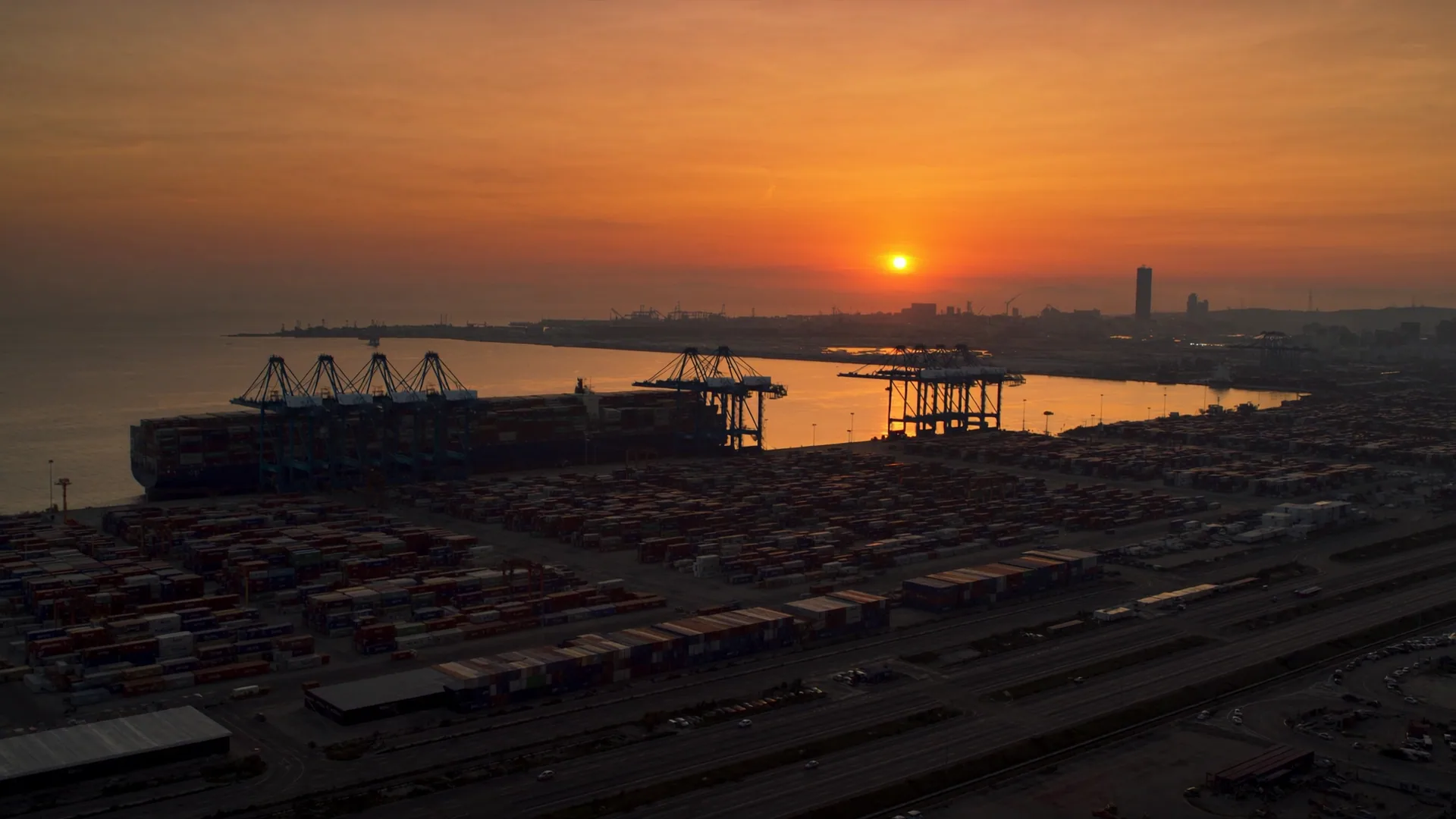
Marmara port connections: the location decision for warehousing and distribution investments
The Kocaeli Gulf port corridor carries a significant share of Turkey's foreign trade volume. The value dynamics of warehouse land near ports and the critical decision points involved.
Abdulbaki Yetis
Environmental Engineer | Real Estate Advisor
The value of land near a port is shaped not by distance alone, but together with port capacity, berth queue (waiting) times, access to bonded (customs) areas, and the direction in which the hinterland (geri saha) is developing.
1. Port type and scope of services
Container ports, bulk-cargo ports, ro-ro ports, and multipurpose ports each create different investment profiles. For a container depot operation, proximity to a container port is most critical; for automotive supply, proximity to a ro-ro port matters more.
The major ports in the Gulf (Aliağa, Asyaport, Gemlik, Yarımca) differ in their areas of specialization. The investment decision should first be made on the basis of service matching.
2. Hinterland development and value appreciation
Land values near a port rise over time together with the development of the hinterland (geri saha). Areas where a motorway connection has been completed, or that have gained bonded-warehouse status, appreciate rapidly.
The critical question for the investor is: 'What is this location's 5-to-10-year infrastructure development timeline?' To answer it, government (ministry) projects and private-sector investments must be tracked together.
3. Bonded warehouse and customs-area status
One of the factors that most increases the value of a warehouse near a port is bonded-warehouse (antrepo) status. A bonded-warehouse license allows imported cargo to be stored before customs clearance is completed; for the importer and the distributor, this means a cash-flow and operational advantage.
If, of two warehouses at the same distance, one holds bonded-warehouse status, their rental and usage values diverge significantly. For this reason, in the investment decision the question 'how close is it to the port' is just as decisive as the question 'what customs/status advantage does this area carry.'
4. Intermodal connectivity: rail and motorway
As much as the port itself, the quality of the exit from the port to the hinterland also generates value. A direct motorway connection, rail (siding/spur line — iltisak hattı) access, and the ability for truck traffic to flow without congestion determine the warehouse's effective capacity.
Locations with strong intermodal (sea + road + rail) connectivity are superior to single-mode connections in both cost and risk distribution. A warehouse dependent on a single route can be operationally paralyzed by any congestion that occurs along that route.
5. Risk: capacity congestion and the alternative-port scenario
The least-discussed risk of investing near a port is capacity congestion. Lengthening berth waiting times, the saturation of hinterland traffic, or the port changing its area of specialization can, over the years, alter a location's appeal. A sound feasibility study looks not at a single port but at the corridor as a whole.
In the Lizaz Emlak approach, warehouse/distribution land near a port is evaluated by reading port type, customs status, intermodal connectivity, and the hinterland development timeline together. The aim is to choose a location that correctly reads not today's distance, but the corridor's ten-year direction of development.
Have a similar file?
Field discipline.
At the center of the decision.
Request a technical pre-assessment from Lizaz with the framework used in this article.
Author
Abdulbaki Yetis
Environmental Engineer · Founder, Lizaz Emlak
Roughly 15 years of industrial-construction site experience. Active assignments at DP World Yarimca port projects, Yildiz Demir Celik steel facility, the Tezcan Galvaniz plant and Symbol Kocaeli shopping mall + hotel + hospital mixed-use project. Reads real estate not as a listing, but as an engineering problem at the intersection of zoning, operations, infrastructure/environment and financing.
Practice areas: industrial real estate · factory and warehouse feasibility · OSB vs. off-OSB investment comparison · residential land and urban transformation · EIA and environmental permit assessment · strategic site selection across the Marmara corridor.
Other research
From the field.
More notes.
Abdulbaki Yetis Analysis
Floor-area-sharing and urban transformation contracts: 6 critical points for property owners from a technical investor's perspective
In urban transformation, the property owner's most critical decision is not which contractor they start with, but which contract they sign. The sharing ratio alone is not a sufficient measure; the land share (arsa payı), the permit timeline, the collateral, the delay penalties and the delivery quality must all be read on the same chart.

Abdulbaki Yetis Analysis
Industrial land decision matrix on the Gebze-Dilovasi-Tuzla corridor: zoning, infrastructure, logistics and environmental risk must be read together
The right decision in industrial land is not made only by square meter price or visible location. On the Gebze, Dilovasi and Tuzla axis, value is understood by reading OSB access, port connectivity, energy capacity, zoning function, environmental permitting and development cost in one technical file.
Residential Land
Residential land and urban transformation feasibility: development rights, infrastructure, sales velocity and cash flow should be evaluated together
The value of residential land does not come only from floor-area ratio. Licensing schedule, infrastructure load, sales velocity, regional income profile and financing cost must be read in one feasibility file.