
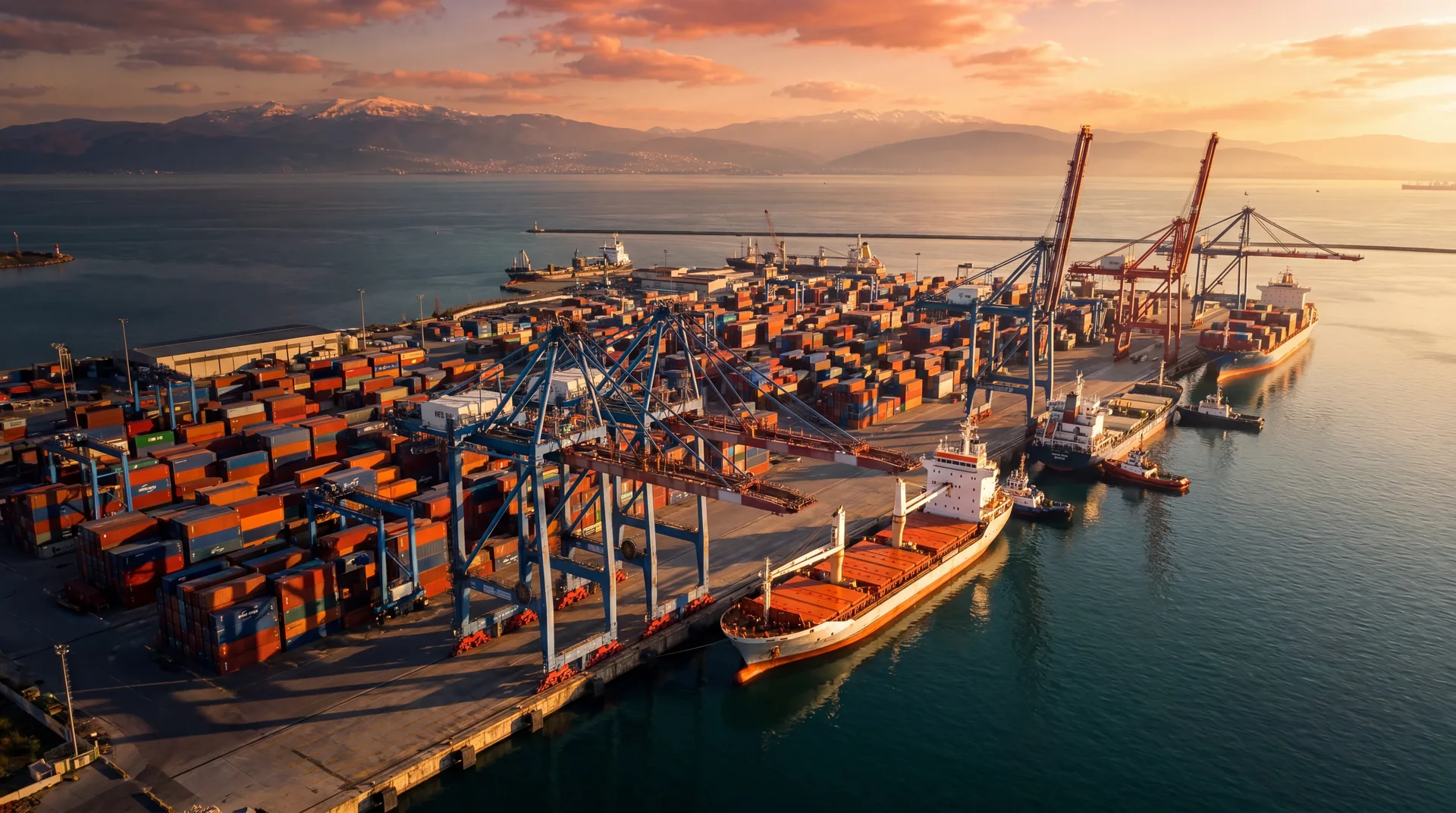
Industrial land inside vs. outside an OSB: the seven technical layers that decide the investment
The most frequently confused dilemma in any industrial investment decision: should the land be acquired inside or outside an OSB? The visible price difference is usually misleading on its own. The real distinction emerges in infrastructure cost, the permitting timeline, environmental risk, exit liquidity, and long-term operational security.
Abdulbaki Yetis
Environmental Engineer | Real Estate Advisor
Choosing inside or outside an OSB is not a cost comparison but a choice about the investment's carrying capacity. The investor reaches the right decision by weighing the production profile and risk tolerance together across seven technical layers.
1. The economic logic of the OSB model and what it means for the investor
Organized Industrial Zones (OSBs) are public-private hybrid structures designed to consolidate industrial production onto a single infrastructure backbone. According to the OSBUK (Organized Industrial Zones Supreme Organization) inventory, more than 300 OSBs are operational across Turkey, with a significant share concentrated along the Marmara, Kocaeli, Sakarya, and Bursa corridor. For the investor, the OSB model means more than just land; it also means shared access to electricity, water, wastewater, natural gas, telecommunications, fire safety, and common service areas.
Buying a parcel outside an OSB brings with it the obligation for the investor to build this infrastructure backbone or to procure it independently. To see this difference, one must look not at the price per square meter but at the 'total cost until the facility begins operating.' In most of the cases I have observed in the field, I find that this calculation has not been done behind the decision to buy cheap land outside an OSB.
Conversely, an OSB location is not automatically the right choice for every industrial investment. As the production profile, logistics requirements, environmental impact level, and intended growth scenario differ, so does the center of gravity of the comparison. For this reason, the two options must be read from the same data set and through the same layers.
2. The infrastructure and cost difference: what you pay, what you get
Purchasing a parcel inside an OSB usually allows the investor to 'plug in' directly to the production infrastructure. Electrical installed capacity is allocated, the natural gas line is brought to the site, the wastewater infrastructure is connected to the OSB's central treatment plant, and stormwater drainage is already planned. In return for these services the investor pays a monthly common charge, a wastewater tariff, and an energy distribution contribution; but they are spared the burden table of building this infrastructure with their own upfront capital.
To establish the same infrastructure on a parcel outside an OSB, the natural gas line must be run in, a transformer must be procured, an in-house treatment plant must be designed and licensed for wastewater, and fire hydrants must be installed. In the field, the per-square-meter equivalent of this investment can range between 20 percent and 60 percent of the land price. The more intensive and chemical-laden the production profile, the larger that share grows.
When making the comparison, the critical question is this: 'Will the per-square-meter premium of the OSB parcel exceed the cost of the standalone infrastructure that would otherwise have to be built later?' Most decisions made without this calculation come back as cash-flow pressure in the second year of the investment.
3. Zoning, the permitting process, and interpreting plan notes
On parcels inside an OSB, the function is already defined as industrial; the floor-area ratio (emsal), setback distances, and building height are set by the OSB's plan notes. For investments that do not require a plan amendment, the permitting process is shorter because infrastructure suitability and use compatibility have been confirmed in advance by the OSB directorate. Headings such as fire-approach distance, parking requirements, and maneuvering area also tend to arrive already clarified for the investor in most OSBs.
On industrially zoned parcels outside an OSB, the situation can be greyer. Even if the function is listed as industrial, the plan notes may contain restrictions such as special industrial area, heavy industry, storage, or process limits. The same 'industrial' stamp opens different doors for galvanizing, chemicals, food processing, or supplier industries. An acquisition made without checking that the function and plan note match the investor's production profile can end with the operating permit being refused after the construction permit.
This difference is especially pronounced on standalone industrial parcels along the Marmara corridor. A parcel 500 meters away from the same OSB, even if it looks similar on paper, encounters a completely different permitting map in practice.
4. Environmental permits and waste management: the hidden cost difference
From an environmental-engineering perspective, this is where the decision becomes determinative. A facility inside an OSB can discharge its production wastewater to the OSB's central treatment plant. This reduces both the investment's upfront budget and the operation's daily burden. As long as the wastewater characterization is kept within the parameters defined by the OSB, the facility is not forced to build advanced treatment on its own.
Outside an OSB, production wastewater must either be treated in your own treatment plant or handed over to a licensed intermediary. For processes high in acid, heavy metals, organic load, or hazardous content, this cost item can settle into the tens of percent of the annual budget rather than a few percent. A reality I observed at facilities using hazardous chemicals, such as the Tezcan Galvaniz site: on a standalone parcel, process economics are not validated by weighing the land price alone, but must be assessed together with the sustainability of operations after permitting.
Air emissions, noise, and solid-waste management differ in a similar way. Inside an OSB, cumulative impact management is assumed by the zone, whereas outside an OSB each facility must obtain and maintain its own permits on its own. Inside an OSB, the investment's 'date of starting operations' is generally pulled forward by six to twelve months.
5. Waiting period, transfer of rights, and exit liquidity
An important characteristic of OSB parcels is that the transfer of rights and the exit process are tied to the institution. There are procedures such as OSB approval prior to transfer, price revision, and the obligation to commence operations. While these procedures limit speculative changes of hands, they also make the market cleaner for serious investors. When a decision to exit is made, the buyer must also be deemed suitable by the OSB.
The liquidity of industrial land outside an OSB is more flexible but more variable. A standalone parcel in the right location with sound infrastructure investment can change hands quickly during a demand cycle; the same parcel may sit in inventory for a long time during a period of shrinking demand. In an out-of-OSB acquisition, the investor must keep the cost of the waiting period and the pool of potential buyers above the price negotiation.
For this reason, the exit scenario must be written deliberately at the acquisition stage. The investment certificate, environmental permit, construction permit, and infrastructure connection documents form a transferable 'package' for a future buyer. Whichever side you go to, the quality of this package determines the exit value.
6. Which investor should go inside an OSB, and which outside?
To simplify the decision: investments with a sensitive production profile, a medium-to-high environmental load, and the need to begin operations quickly generally find safer conditions inside an OSB. These include automotive supplier industries, plastic and metal processing, chemical processes, and food-processing facilities. Likewise, for institutional investors or foreign-capital production facilities, the institutional security the OSB model provides is a reason for preference.
Conversely, for investments that are large-scale in production profile, whose logistics cycle is directly dependent on main arteries and the port, and whose area exceeds the standard parcel sizes within an OSB, a standalone parcel outside an OSB may be more rational. Logistics facilities requiring large storage areas, factories producing heavy machinery and requiring special facades, or investors needing direct rail or port access fall into this group.
There is one more, intermediate category: investors who acquire industrial land outside an OSB, build its infrastructure, and over the medium term seek to elevate it to the status of a new special industrial zone. This path is long and regulation-heavy, but when done correctly it generates a substantial premium in exit value. For this kind of development, a technical advisory team with field experience is essential.
7. The decision matrix: scoring the seven layers
In the Lizaz Emlak approach, every investment file is scored across seven layers: price and total upfront cost, infrastructure suitability, zoning and plan-note compatibility, the environmental permit profile, logistics access, the waiting and permitting timeline, and exit liquidity. Each layer receives a score between 1 and 5, and by examining the overall table the two options are brought onto the same footing.
The purpose of this matrix is to separate the decision from emotion. The investor looks not at single-variable emphases such as 'cheap land' or 'OSB security,' but at the file as a whole. In the field, this approach significantly narrows the investor's margin of error, especially during periods of high interest rates and volatile costs.
Once the seven layers are scored, the resulting table often produces an outcome different from what was expected. The seemingly expensive OSB parcel is safer in the overall decision table; the seemingly cheap out-of-OSB parcel, together with its uncounted infrastructure and permitting costs, can turn out riskier. The right decision is the one the table speaks, not the one the price speaks.
Have a similar file?
Field discipline.
At the center of the decision.
Request a technical pre-assessment from Lizaz with the framework used in this article.
Author
Abdulbaki Yetis
Environmental Engineer · Founder, Lizaz Emlak
Roughly 15 years of industrial-construction site experience. Active assignments at DP World Yarimca port projects, Yildiz Demir Celik steel facility, the Tezcan Galvaniz plant and Symbol Kocaeli shopping mall + hotel + hospital mixed-use project. Reads real estate not as a listing, but as an engineering problem at the intersection of zoning, operations, infrastructure/environment and financing.
Practice areas: industrial real estate · factory and warehouse feasibility · OSB vs. off-OSB investment comparison · residential land and urban transformation · EIA and environmental permit assessment · strategic site selection across the Marmara corridor.
Other research
From the field.
More notes.
Abdulbaki Yetis Analysis
Floor-area-sharing and urban transformation contracts: 6 critical points for property owners from a technical investor's perspective
In urban transformation, the property owner's most critical decision is not which contractor they start with, but which contract they sign. The sharing ratio alone is not a sufficient measure; the land share (arsa payı), the permit timeline, the collateral, the delay penalties and the delivery quality must all be read on the same chart.

Abdulbaki Yetis Analysis
Industrial land decision matrix on the Gebze-Dilovasi-Tuzla corridor: zoning, infrastructure, logistics and environmental risk must be read together
The right decision in industrial land is not made only by square meter price or visible location. On the Gebze, Dilovasi and Tuzla axis, value is understood by reading OSB access, port connectivity, energy capacity, zoning function, environmental permitting and development cost in one technical file.
Residential Land
Residential land and urban transformation feasibility: development rights, infrastructure, sales velocity and cash flow should be evaluated together
The value of residential land does not come only from floor-area ratio. Licensing schedule, infrastructure load, sales velocity, regional income profile and financing cost must be read in one feasibility file.