
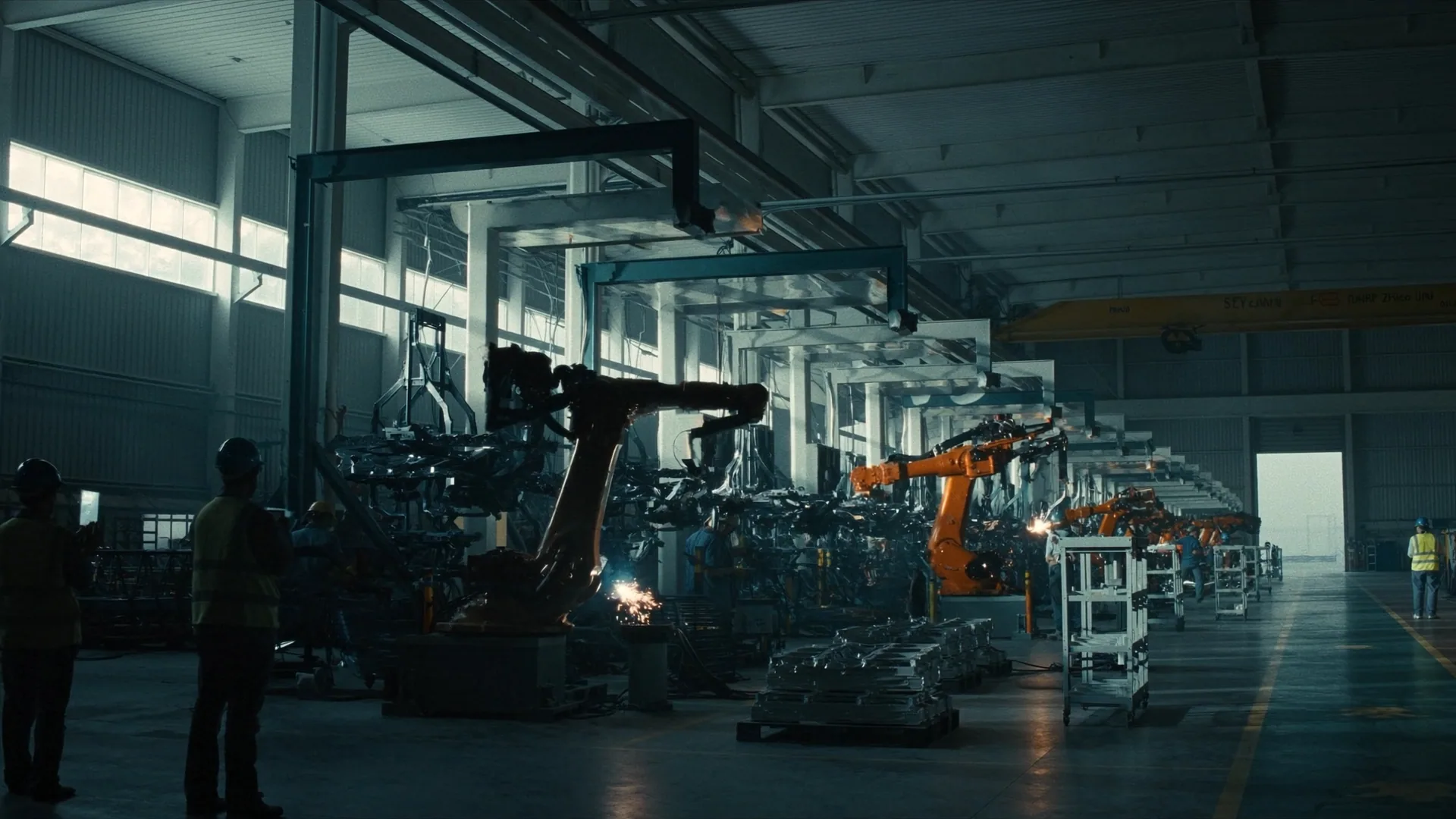
Location strategy for the automotive supply industry: OEM proximity and the supply chain
In automotive supplier investments, proximity to the OEM (original equipment manufacturer), just-in-time delivery capability, and access to a skilled workforce are more decisive on their own than the price per square meter.
Abdulbaki Yetis
Environmental Engineer | Real Estate Advisor
The right plot for a supplier facility is not the cheapest plot; it is the one that enters the OEM's supply radar the fastest and disrupts the logistics cycle the least.
1. OEM proximity and delivery time
The modern automotive supply chain has moved to the JIT (just-in-time) model and increasingly to the JIS (just-in-sequence) model. Under these models, the supplier is expected to be able to deliver to the OEM within 30 to 60 minutes.
Although plot prices near the OEMs located along the Bursa, Kocaeli, and Sakarya corridor carry a premium, supply capability forms the foundation of the investment. Distant plots are forced to offset this disadvantage with logistics costs.
2. Access to a skilled workforce
Access to qualified workers, engineers, and technicians is critical to a facility's success. Proximity to vocational high schools, technical universities, and training institutions should be assessed.
The cost of worker shuttle circulation is a hidden component of the location decision. Although the annual shuttle budget may appear modest, over a 10-year horizon it accumulates to a significant sum.
3. Infrastructure and energy capacity
Automotive supplier facilities (pressing, welding, painting, plastic injection) require high and stable energy. The transformer capacity the plot is connected to, the natural gas line, and, where required, the compressed air/water infrastructure directly determine whether the production line can even be installed.
Reinforcing energy infrastructure after the fact is both costly and time-consuming. While this capacity often comes ready-made with a parcel inside an OSB (organized industrial zone), on a plot outside an OSB the investor must separately factor in connection fees and the time they require.
4. Expansion flexibility and plot size
As OEM orders grow, the supplier needs to add production lines. A plot that fits 'perfectly' for today's needs can turn into a bottleneck three years later. The right decision accounts not only for the current production area but also for the reserve needed for future expansion.
Parcel geometry also determines flexibility: a clean geometry that accommodates loading ramps, maneuvering space, and a possible additional building is far more valuable than a narrow and irregular parcel. A location with no possibility of expansion is a hidden ceiling for a growing supplier.
5. Deciding by total cost of ownership (TCO)
The supplier location decision must be made on the basis of total cost of ownership rather than price per square meter: land cost + logistics cost + shuttle/workforce access + energy connection + expansion flexibility. When these line items are added together, the 'cheap' plot often turns out to be the most expensive option.
In the Lizaz Emlak approach, an automotive supplier plot is quantified by placing OEM proximity and the supply cycle at the center, together with the infrastructure, workforce, and expansion layers. The goal is not to select the lowest sticker price, but the location that builds the most solid ten-year production economics.
Have a similar file?
Field discipline.
At the center of the decision.
Request a technical pre-assessment from Lizaz with the framework used in this article.
Author
Abdulbaki Yetis
Environmental Engineer · Founder, Lizaz Emlak
Roughly 15 years of industrial-construction site experience. Active assignments at DP World Yarimca port projects, Yildiz Demir Celik steel facility, the Tezcan Galvaniz plant and Symbol Kocaeli shopping mall + hotel + hospital mixed-use project. Reads real estate not as a listing, but as an engineering problem at the intersection of zoning, operations, infrastructure/environment and financing.
Practice areas: industrial real estate · factory and warehouse feasibility · OSB vs. off-OSB investment comparison · residential land and urban transformation · EIA and environmental permit assessment · strategic site selection across the Marmara corridor.
Other research
From the field.
More notes.
Abdulbaki Yetis Analysis
Floor-area-sharing and urban transformation contracts: 6 critical points for property owners from a technical investor's perspective
In urban transformation, the property owner's most critical decision is not which contractor they start with, but which contract they sign. The sharing ratio alone is not a sufficient measure; the land share (arsa payı), the permit timeline, the collateral, the delay penalties and the delivery quality must all be read on the same chart.

Abdulbaki Yetis Analysis
Industrial land decision matrix on the Gebze-Dilovasi-Tuzla corridor: zoning, infrastructure, logistics and environmental risk must be read together
The right decision in industrial land is not made only by square meter price or visible location. On the Gebze, Dilovasi and Tuzla axis, value is understood by reading OSB access, port connectivity, energy capacity, zoning function, environmental permitting and development cost in one technical file.
Residential Land
Residential land and urban transformation feasibility: development rights, infrastructure, sales velocity and cash flow should be evaluated together
The value of residential land does not come only from floor-area ratio. Licensing schedule, infrastructure load, sales velocity, regional income profile and financing cost must be read in one feasibility file.